
Remember Me
 impressed
As I enter my username and password to the back-end of this site, I click the little ‘Remember Me’ button. If only it were so easy.
Memory is a tricky goose. It appears as if a bell curve, and certainly not binary. Our earliest memories begin years after our entrance into this world, and our final memories disappear as soon as they appear, if we are lucky enough to have what remains of a memory in our final moments and years.
Not Dark Yet
I read recently with some sadness about writer Seth Rogovoy’s recent Parkinson’s diagnosis, a process I am all-too-familiar with having watched it melt away my brilliant grandfather over time. Pop-Pop’s sharp, acerbic wit coupled with his professional knowledge in law and engineering were his defining features. And so too, goes all the memory and knowledge with it. It seems appropriate that the Dylan song I have most been focused on this month, Not Dark Yet, captures this chapter:
Sometimes my burden seems more than I can bear
It’s not dark yet, but it’s getting there
I was born here and I’ll die here against my will
I know it looks like I’m moving, but I’m standing still
Dylan seems torn on the idea of who is moving and who is standing still, us or time. He contains multitudes after all, as he says in the NY Times recent featurette On Being 80, “when you’re young you think that time moves forward. At 80 you know that it doesn’t, it stands still. We’re the ones that move.”

Train Wheels Runnin’ Through the Back of My Memory
Rogovoy’s own archive is spanned across multiple websites, a sort-of treasure hunt across Substacks and WordPresses and old HTML troves. His writing and first-hand accounts of the blossoming alt-klez scene in New York and surroundings makes me feel a deep sense of anemoia, a nostalgic longing for a place I never was. That is one thing that all of these iconic writers and chroniclers of musical history have in common: the way they elicit in me a sense of placelessness in my present and a belonging to something simultaneously infinite and finite.
Barbara Kirschenblatt-Gimblett recently posted on Facebook that she was conducting an interview with Mark Slobin for an upcoming Festschrift. And as I continue my research, so many luminaries reaching retirement, folks I admire and look up to, now emerita…
Just a few that come to mind, and many others… Jeffrey Summit, who recorded and wrote liner notes for the album on Abayudaya music for Smithsonian Folklife. Kay Shelamay at Harvard. Benjamin Brinner at Berkeley. I don’t know if Philip Bohlman is retiring, but University of Chicago is winding down many humanities programs, including their ethnomusicology department. Dr. Kirschenblatt-Gimblett, herself, of course, from NYU.
Sunrises and sunsets, but with them, deep encyclopedias of inherited and hard-earned knowledges. And though much of their research is contained in books, how am I supposed to read and acquire all of that knowledge in just one lifetime, while balancing my jobs and responsibilities, especially to Jasper, my dog, who looks annoyingly at me when I’m in a deep-think and should be walking him instead.
Everything is Broken (404)
And relatedly, my near-obsession with physical media and digital archiving, as I watch the internet disappearing before our eyes. Broken links everywhere. The Internet Archive under attack. History being erased from our national landmarks and foundational documents let out to wither.
It may be that their writings open up to me the vast trove of songs almost forgotten. And with that near-involvement of musical memory, it becomes my prerogative, my responsibility, my burden to remember, lest the song be lost and forgotten, a prayer never to be uttered again.
I wrote recently, well, spoke into my notes app, some thoughts as I am reading and encountering Josh Kun‘s Audiotopia on many levels of interest and understanding. Those audiotopias, “of music as an enacted, lived utopia that struggles against the constraints of racialization and nation-building in order to configure an alternate world of survival” have been deep on my mind.
“Music is a codex of memory,” I thought. “It is a living, dynamic poem, written at some point and yet belonging to the present. A song cannot be owned once birthed. It lives an eternal life until it is forgotten. It is more an instrument for keeping time than it is bound by it.”
If I seem pre-occupied by death and memory lately, it perhaps is because I am more deeply diving into studies of memory, collective, in particular. If a critical function of fascism is the erasure of history, then time, I suppose is Mussolini in disguise. Hey Siri, play Lowell’s “G!d is a Fascist”.
The sun seems to shine here forever
I’ve learned to crave shitty weather
Something to make me feel human
Like LA ain’t one big illusion, yeah
Every Grain of Sand
In hopes of better understanding and resisting the erosion, I just had the first workshop in a summer-long metadata training from UCLA’s Modern Endangered Archives Program (MEAP). And while I am not yet custodial over any specific archive, I find myself regularly moving around terabytes of data and digitizing records and printed material that I cannot find anywhere else on the internet. Last week, three new records acquired of Jewish music produced in summer camps in the 1970s. Two of them are not on Discogs or MusicBrainz.
Geeking out on metadata is a longtime special interest. One of my music mentors at the Academy for the Performing Arts, the great Mike Simmons, once gifted me with a massive library of meticulously organized mp3s. Somewhere along the line, those files died out on an external drive that got too shaken and not stirred. Those old external HDD enclosures on FAT32 file systems moving around from dorm room to dorm room, those files never stood a chance. But it instilled in me a respect for ID3 and I remember how often I would organize my iTunes playlist to find any file missing Artist tags. That practice continues today, with complex file management systems utilizing MusicBrainz Picard, Mp3tag, Lidarr, VinylStudio, and custom scripts that source and match lyric files to all of my music.
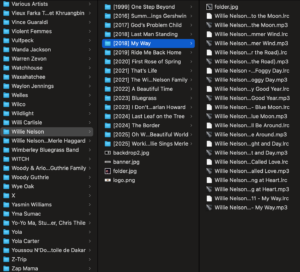
My current efforts are more resilient, time-intensive, and expensive. I am currently in flow on setting up my secondary back-up NAS which will be stored in California, the most secure spot I have outside of Baltimore. Inconvenient if I need to do an actual restoration but at least completely protected from regional natural disasters.
Buying two new 14TB drives has become financially repressive in the current storage war we are in as AI influxes the cost of storage to nearing double what it was just a few years ago. So, two used drives from eBay with 35,000 hours are now sitting in a two-bay NAS as I set up my mirror and seed. They appear to be healthy enough per the S.M.A.R.T tests. Just between my two NAS set-ups, we are totaling near 70TB of base storage (split up into a variety of RAID components). It has been thousands of dollars and thousands of hours just to break up with Cloud services.
For me, it has been worth every penny and minute, for everything I’ve learned along the way. Perhaps this tension between the cloud and physical media is a metaphor for my own discomfort with my own mortality. One day, all that I have experienced will move into the great cloud in the sky. I remember when we brought Natalia Lafourcade to the Musco Center for the Arts. Her version of “Remember Me” from Coco…
Te llevo en mi corazón y cerca me tendrásA solas yo te cantaré soñando en regresar
(For even if I’m far away I hold you in my heart
I sing a secret song to you each night we are apart)
On the Final Approach
I don’t know if I struggle more than others with this idea of personally and collectively losing knowledge and losing mentors and losing the depths of experience. Or maybe everyone feels this way and we don’t talk about it as much as I think we should. Or maybe everyone’s talking about it and I’m just one voice in the chorus of those furious with G!d about the unfair deal we’ve been dealt: to experience the divine for such a short time.
And I suppose I should wrap this post up, but first I gotta link to a great new release from the incredible Swamp Dogg, whose new record Swamp Dogg Contemplates the Afterlife is, in his typically too-honest, too-real, a Final Approach to the one damn thing we surely all have in common.
I said goodbye to the runaway me
Opened the door and set the captive free
Marked every storm that I made it through
Kept every scrap that the fire grew
My name is in the logbook, signed in grace
Worn out, the doubts have shattered my faith
If mercy is fuel, then I’ve got enough
I’m taxiin’ home, smooth on the run
Sidewalks, Fences, and Walls: An Addendum
Writing this made me wonder whether Swamp Dogg and Bob Dylan ever had any connection. Sure enough, there is a great one, thanks to Dylanoligist Tony Attwood. Dylan recorded a version of “Sidewalk, Fences, and Walls” in 1986/7, available in the outtakes for Down in the Groove. Dylan would have heard the version by Solomon Burke, who he shared a mutual admiration for. The song was originally written by the “Southern soul music maverick Jerry (Swamp Dogg) Williams, Jr.”
Like it’s the last night of our livesWe’ll keep dancin’ till we die