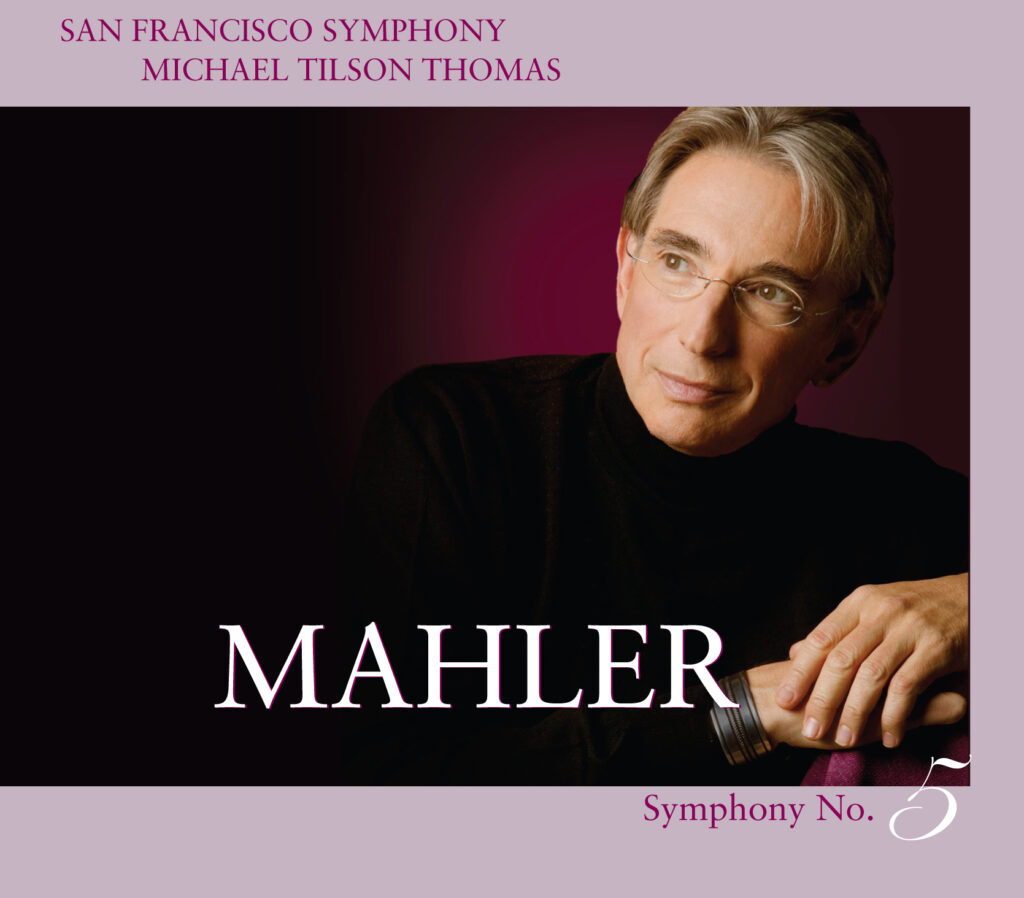
It seems strange, really quite strange, that sitting at the top of my music library tonight, the most recently added album, and there have been many recently, is Mahler’s 5th with the face of the MTT on the cover. Just three days after I added it, with the intention to listen to it in the next week, I read the news today of the death of the great conductor, composer, and arts leader.
The news broke into my feed from the Milken Center, via UCLA’s Lowell Milken Center for Music ofAmerican Jewish Experience. While so many organizations and artists are honoring the Maestro, it is fitting for the Milken Center to acknowledge Tilson Thomas’ family roots in the Yiddish theater, and his unique position of carrying on the Thomashevsky legacy to new heights, a capstone on a story that mirrors, magnifies, and personifies the Jewish experience in America.
Juxtaposed with the complexity of Mahler’s thundering dissonant pageantry, I sit down to reflect on that narrative. And Tilson Thomas is considered to be a particularly masterful interpreter of Mahler, for reasons that I’m sure would be fun to learn.
From the liner notes, Mahler is quoted as writing to his wife Alma:
“Heavens, what is the public to make of this chaos in which new worldsare forever being engendered, only to crumble into ruin the next moment?What are they to sayto this primeval music, this foaming, roaring, raging sea of sound, to thesedancing stars, to these breathtaking, iridescent, and flashing breakers?“
Maybe that’s where Tilson Thomas got the idea to name the New World Symphony. It was in this New World, cat-free, that the forms of Mahler, Schoenberg, and other Jewish free-thinkers of the late 19th and early 20th century were able to find suitable space to explore.Now that I think of it, the UCLA performance hall is named after Schoenberg, so it all does seem relevant. And as high brow as it all seems—universities, institutions, atonal experimentations—it’s still showbiz, baby.
MTT’s grandfather, the great Boris Thomashevsky, was a pioneer in Yiddish theater, yes, but also in developing the model of touring acts around the country. We think sometimes of the Yiddish theater as high art, I mean, it’s THE THEATRE. But back in the 1880s, there wasn’t much in New York to entertain yourself with. No radios, no nickelodeons, no player pianos (almost though!). Much of the theatrical output of the time was shund.
And I’m going to get way beyond my expertise here if I keep going further on it. Suffice it to say, that these were enterprising times. The capacity to go where audiences were, to meet them as they are, to entertain them, that is something I always looked up to in Michael Tilson Thomas.
I think that was in his DNA. His prominence in Miami, and then the West Coast, follows the trajectory of Jewish migration of the 20th century. A protégé of Bernstein, he earned his stardom in an era where, thanks to radio, conductors were household names. And at the same time, Tilson Thomas was also an icon within the Gay community, a prominent figure in a stodgy world of classical music, and during the tumultuous death-riddled AIDS era.
I got to see MTT conduct just once, out here in Washington D.C. in 2022. At the Kennedy Center, actually, just before it went to the birds. It was a thrilling night, with him conducting Copland’s Appalachian Spring, and his own fusion classical/jazz/theatrical experience, “Four Preludes on Playthings of the Wind,” based on the Carl Sandburg poem of the same name.
The woman named Tomorrow sits with a hairpin in her teeth and takes her time and does her hair the way she wants it and fastens at last the last braid and coil and puts the hairpin where it belongs and turns and drawls: Well, what of it? My grandmother, Yesterday, is gone. What of it? Let the dead be dead.
…
It has happened before. Strong men put up a city and got a nation together, And paid singers to sing and women to warble: We are the greatest city, the greatest nation, nothing like us ever was.
…
And the wind shifts and the dust on a door sill shifts and even the writing of the rat footprints tells us nothing, nothing at all about the greatest city, the greatest nation where the strong men listened and the women warbled: Nothing like us ever was.

 energetic